



It’s the bane of any corporate worker’s life… the dreaded deadline to complete mandatory annual Computer-Based Training (CBT) modules, which seemingly get longer with each passing year. The desperate scramble to click through a never-ending slideshow only to be hit by an exam at the end is a well-trodden path for many workers across various industries.
This is no more true than in the airline industry, where flight attendants not only have to attend in-person ‘recurrent’ training every year but also have a long list of CBT modules to complete in order to be allowed to continue flying. Failure to complete the CBT training is a disciplinary offense that could ultimately result in termination.
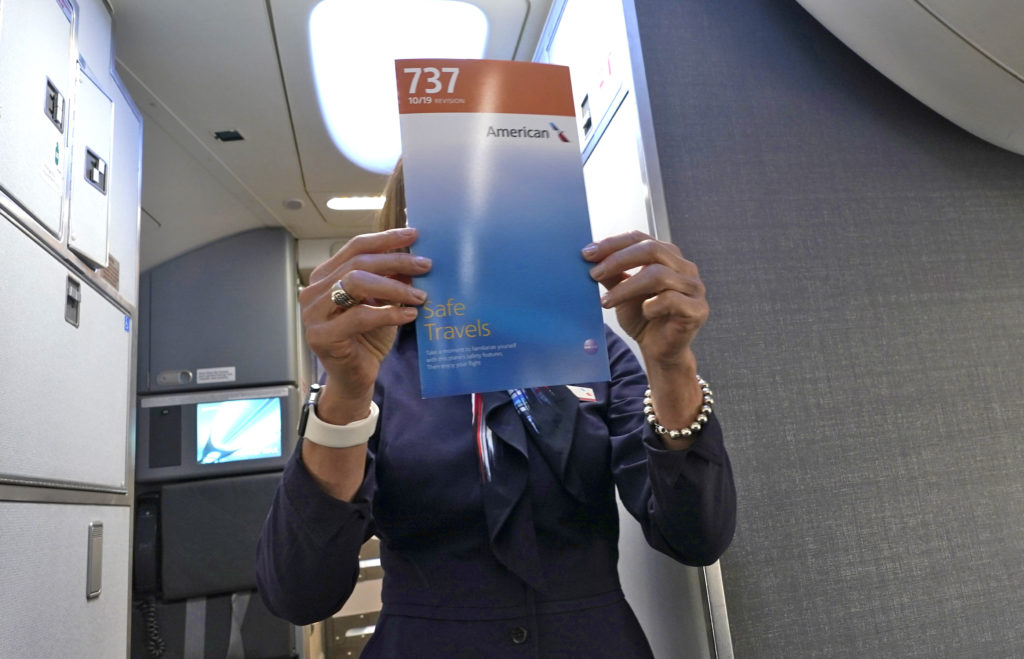
Now, however, flight attendants at American Airlines are challenging the amount of time that it takes to complete these CBT modules, and the dispute has gotten so messy that the Association of Professional Flight Attendants (APFA) is taking the disagreement to independent arbitration.
Officially, American Airlines claims that the annual CBT syllabus shouldn’t take any longer than eight hours to complete, and flight attendants are actually paid to complete these modules.
As part of the flight attendant contract, crew members are required to complete three days of recurrent training per year (known at American Airlines as CQ or Continuing Qualification training). Two days of CQ are held at the carrier’s main training center in Dallas, where flight attendants must show they are competent to operate aircraft doors and conduct an evacuation, as well as complete an annual First Aid refresher.
Flight attendants are compensated $150 per day of CQ, which is based on an eight-hour workday. In addition to the two days of in-person CQ training, flight attendants are also paid an additional $150 to complete their CBT modules.
Again, the $150 compensation is based on the CBT syllabus, taking no more than eight hours to complete.
However, flight attendants report that the idea that American Airlines’ ever-expanding CBT package takes just eight hours to complete is far-fetched, to say the least.
Of course, American Airlines should have the data to prove exactly how long it takes flight attendants to complete all these modules. After all, CBT courses track every mouse click, and it should be easy to determine the average time it takes to complete the package and how many flight attendants are exceeding the eight-hour limit.
American Airlines has, however, refused to hand over this data to APFA.
The union wants the Texas-based carrier to offer a remedy for flight attendants working over the eight-hour limit to complete their annual CBT, but after American Airlines declined to offer one, the dispute is now headed to arbitration.
And while American Airlines is refusing to hand over the data that might prove whether APFA has a case, it’s now transpired that flight attendants can download their own training transcripts to prove how long it takes to complete the CBT package.
If you were being really cynical, you might argue that flight attendants could be inclined to take longer on their CBT modules in order to build evidence for the union, although it’s hard to believe that anyone would want to endure the nightmare of computer-based training for any longer than is absolutely necessary.
An arbitrator may, however, rely on evidence from the airline that proves its package of modules really can be completed in eight hours or less. No date has yet been set for when the hearing will take place.