



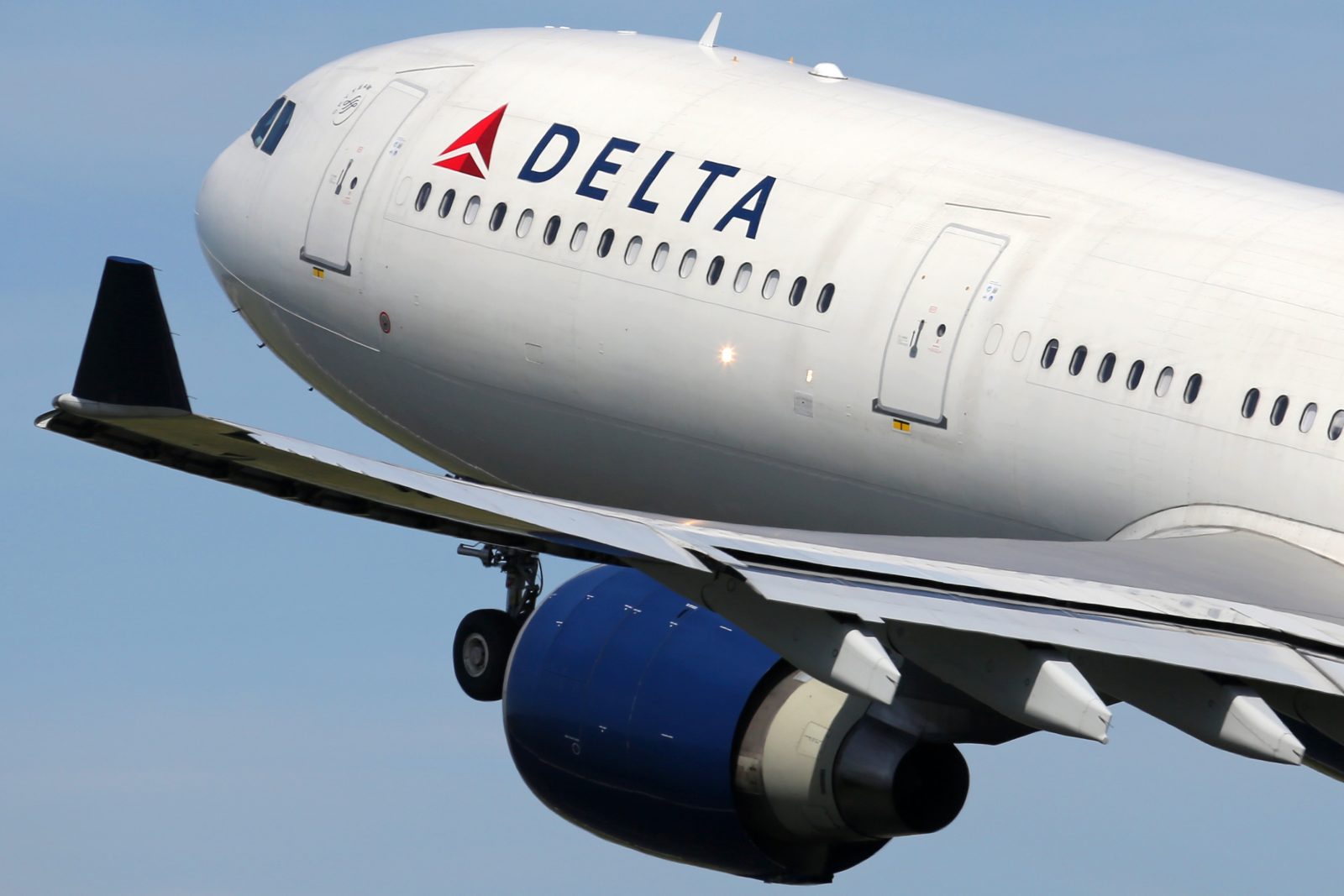
A Delta Air Lines flight from London to Boston with 259 passengers onboard made an emergency diversion just minutes after takeoff on Sunday morning, after fumes reportedly started to fill the cockpit as the plane was still in its ascent to cruising altitude.
The incident comes just days after it was revealed that the Atlanta-based carrier was replacing hundreds of ‘Auxiliary Power Units’ on its Airbus A320 series aircraft as part of a concerted attempt to prevent so-called contaminated air events.

Sunday’s incident occurred on a larger Airbus A330 widebody jet, which is less than four and a half years old and delivered new from the Airbus factory in Toulouse, France, in May 2021.
Delta flight DL-59 from London Heathrow to Boston Logan took off from Runway 27R at around 10 am on October 5 and started to climb to its cruising altitude, flying off the coast of Cornwall before suddenly turning back towards the UK.
Onboard the plane, many passengers had little idea of why they were turning back, with the crew telling them that an unidentified mechanical issue had cropped up.
Some passengers, however, soon realized something might be amiss when the aircraft made a sharp 45-degree turn over South London to get onto the correct path for final approach into landing.

Once on the ground, the plane was surrounded by airport vehicles, and fire officials boarded the aircraft before passengers were eventually sent in buses to the airport terminal.
There are reports that ‘fumes’ were detected in the cockpit, which would normally require the pilots to don special breathing apparatus before making preparations for an immediate diversion.
In this case, the aircraft was loaded with enough fuel for a transatlantic flight, but rather than entering a holding pattern to dump fuel and lower the aircraft’s weight, the pilots decided it was safer to land as soon as possible but with additional weight.
In a statement, a spokesperson for Delta commented: “Delta flight 59 from LHR to BOS on October 5 landed safely after returning to LHR due to reports of smoke in the aircraft.”
“The flight will operate tomorrow, and Delta’s customer team is assisting customers with accommodations and rebooking. We apologize to our customers for the delay, but safety for our customers and crew will always be Delta’s top priority.”
On September 25, the Wall Street Journal revealed that Delta had been working on a secret program since 2022 to replace the Auxiliary Power Units (APUs) on its single-aisle Airbus aircraft.
The APU is a small additional engine that is located in the tail of an aircraft. It provides the plane with power while it is on the ground and is used to start the main engines.
Some campaigners believe the Airbus A320 series has a known design flaw that increases the risk of cabin air becoming contaminated with dangerous pollutants such as engine oil from the APU.
Older APUs are also more susceptible to a fume event, so replacing these with newer units should mitigate this risk.
The APU replacement program may not, however, reduce the risk of ‘bleed air’ contamination. Most aircraft supply air to the cabin by ‘bleeding’ a small amount of air that is sucked into the aircraft engine and feeding it into the air conditioning system.
Because the air is being bled off the engines, it can become contaminated with engine oils and lubricants that vaporize on a hot engine.
The only commercial aircraft that does not use the bleed air system is the Boeing 787 Dreamliner.
Although bleed air contamination is believed to be a major source of fume events, other sources, like electrical problems or even a strong chemical cleaner, have been known to cause issues in the past.
While airlines and aircraft manufacturers acknowledge that fume events can be disconcerting, they insist that the vast majority of people who are caught up in one of these incidents will only experience short-term, non-serious issues such as headaches and runny eyes.
There are, however, numerous cases of victims suffering “permanent and serious injury” following a fume event.