



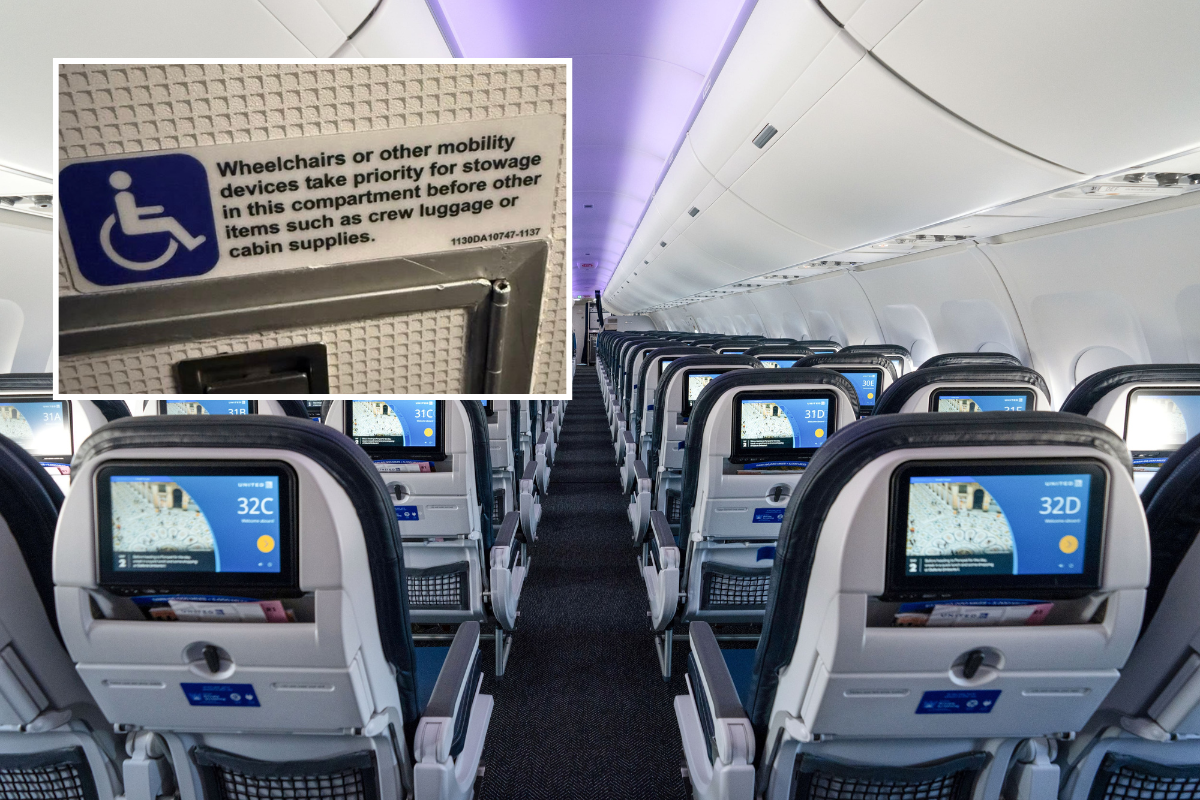
A United Airlines flight attendant refused to let a disabled passenger store their bespoke wheelchair in an onboard closet designed specifically for this exact purpose because the crew’s baggage was taking up all the room in the closet, and they were unwilling to move their bags to another stowage.
Sarah Bambur was recently traveling with her disabled husband on a long-haul flight and explained what happened in a Facebook page dedicated to passenger experiences flying with United Airlines.
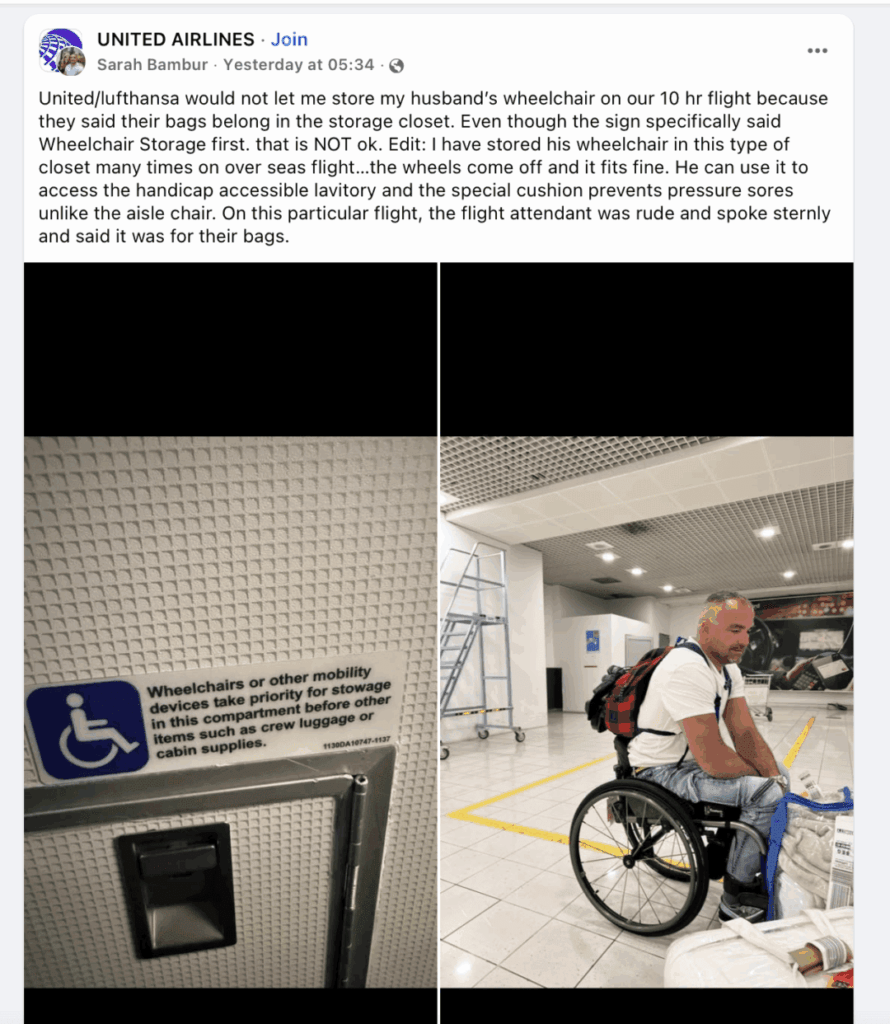
“United/Lufthansa would not let me store my husband’s wheelchair on our 10 hr flight because they said their bags belong in the storage closet,” Sarah wrote in her post.
“Even though the sign specifically said Wheelchair Storage first. That is NOT ok,” Sarah continued.
But after being bombarded with comments stating that she was in the wrong and that her husband’s wheelchair belonged in the cargo hold, Sarah had to add additional information.
“I have stored his wheelchair in this type of closet many times on overseas flights…the wheels come off and it fits fine. He can use it to access the handicap accessible lavatory, and the special cushion prevents pressure sores, unlike the aisle chair.”
To make matters worse, Sarah claims the flight attendant didn’t exactly handle the situation with much empathy: “On this particular flight, the flight attendant was rude and spoke sternly and said it was for their bags,” Sarah added.
It’s not hard to see why disabled passengers want to bring their wheelchairs on board with them
Aside from the obvious benefit of being able to use their own custom wheelchair rather than an uncomfortable onboard aisle chair, the shocking statistics of mishandled wheelchairs compiled by the Department of Transportation really show why disabled passengers don’t want to check their wheelchairs into the cargo hold.
In July 2025, which is the most recent month for which data is available, United Airlines was one of the worst offenders, mishandling 151 wheelchairs in a single month – which works out to 1.35 mishandled wheelchairs per 100 enplaned.
Frontier Airlines, American Airlines, Spirit Airlines and Hawaiian Airlines performed even worse, while Delta Air Lines scored the best in the least number of mishandled wheelchairs.
So what are the rules in this situation?
It appears that Sarah is very much in the right. A law dating back more than 17 years requires US-registered airlines and any foreign airline flying to or from the United States to provide a designated space in the cabin for at least one manual wheelchair that can be folded down.
The law was enacted in 2008 as part of an amendment to the Air Carrier Access Act under 14 CFR § 382.67, which states that airlines operating airplanes with 100 seats or more must provide a designated wheelchair storage space.
In most cases, this will be a closet somewhere in the passenger cabin. This closet will ordinarily be used for flight attendant stowage, but, as was the case on Sarah’s flight, the closet will have a placard that specifically states that priority goes to wheelchair stowage if requested.
The wheelchair should only be placed in the cargo hold if it’s too big to fit in the designated stowage area or if more than one passenger has requested the space. In these circumstances, the space is occupied on a first-come, first-served basis.
Only manual wheelchairs are permitted in this dedicated stowage area, whereas electric wheelchairs and mobility devices will be stored in the cargo hold.
The comments on Sarah’s post suggest that even though this regulation has been in place for nearly two decades, there is still a lot of confusion amongst crew members, with many not realizing their obligations to clear out their baggage to make room for a passenger’s manual wheelchair.
But the regulations are very clear, with one section explaining: “You must move items that you or your personnel have placed in the priority stowage area (e.g., crew luggage, an on-board wheelchair) to make room for the passenger’s wheelchair, even if these items were stowed in the priority stowage area before the passenger seeking to stow a wheelchair boarded the aircraft.”
In September 2023, United Airlines promised to improve the service it provided to wheelchair users after an investigation by the Department of Transportation into the death of a disabled passenger who sustained injuries while sitting in a temporary manual wheelchair because her customized wheelchair had been damaged by the airline.
Engracia Figueroa died in the ICU in October 2021 after an ulcer that had developed from sitting in the temporary wheelchair became infected.
Just months after promising wheelchair service improvements, United reached a $30 million deal to settle a lawsuit brought by the family of a quadriplegic passenger who was left in a permanent coma following a deplaning accident in February 2019.
The family of Nathaniel Foster Jr. sued United Airlines after he went into cardiac arrest as ground staff attempted to move him off a United Express plane at Monroe Airport in Louisiana, where they were visiting to attend a family funeral.


United. Yup. This is in keeping with what I know about he worst airline out there. I’ll fly Delta even if I have to pay more….
*knock knock* This is the ADA! Open up!
I am surprised that the story did not include the FA calling police for interference with the flight crew. These power playing FA’S need to be reigned in.
UNITED looked over at the crappiest customer service at AA and said, i can be worse…