



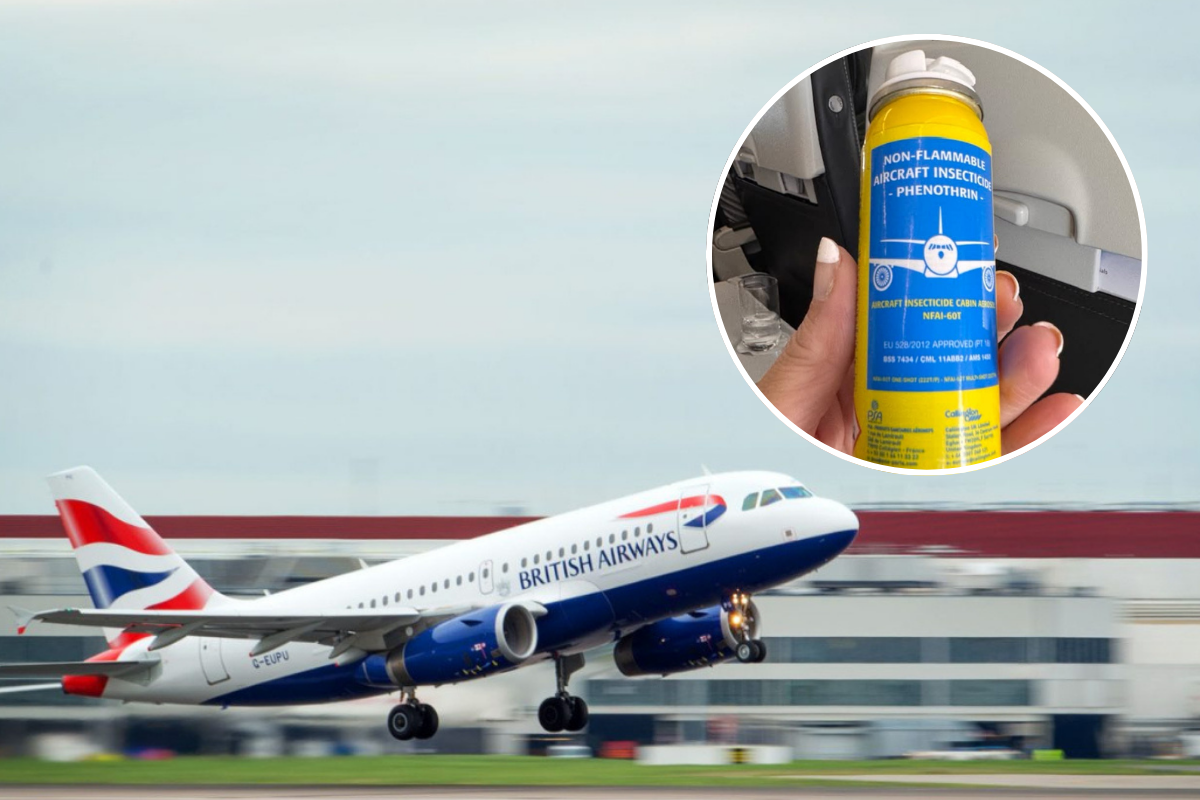
A British Airways passenger has slammed the airline, saying she would never have gotten on a recent flight from London Heathrow to Rome, Italy, if she had known that she would be “sprayed down” with what she has described as a “toxic” insecticide.
Melissa Arana took to Facebook to explain what happened and disclosed that one of the cabin crew members admitted to her that he was “livid” with being made to regularly spray the insecticide in an enclosed airplane cabin.
“Flying into Rome from London on British Airways, I was sprayed with a chemical that is a toxic insecticide/pesticide,” Melissa wrote. “Of course, this was never disclosed upon purchasing the ticket.”
Melissa added, “Had I known the requirement was being sprayed down, I would’ve never taken that trip.”
In another comment, Melissa added that the pre-takeoff spraying was “disgusting beyond words. What if children have asthma or anaphylactic shock, or better yet, adults with COPD or emptiness? They took zero consideration for personal health matters.”
While British Airways may not have advertised during the booking process that insecticide spraying was going to occur on Melissa’s flight, the airline does have a dedicated page on its website that explains routes where spraying takes place and what is inside the spray.
What is aircraft disinsection?
Until recently, insecticide spraying was limited to destinations considered more tropical or exotic, and it has actually been around for many years. Known as ‘disinsection’ within the aviation industry, the sprays contain synthetic pyrethroids such as Phenothrin or Permethrin, which are effective at killing a variety of pests such as mosquitoes, houseflies, and cockroaches.
Of primary concern to health authorities is the risk of airplanes transporting mosquitoes carrying diseases like Malaria, Zika, or Dengue Fever. Airlines are often required to spray the cabin before passengers have boarded the plane, and then a second time once all the doors have been closed.
Health officials have had the legal right to impose disinsection requirements on airlines since 1944, when an international aviation treaty known as the Chicago Convention was signed.
The Chicago Convention established the International Civil Aviation Organization, which is a specialist body of the UN. Together with the World Health Organization, the two agencies have approved certain insecticides that can be used in airplane cabins.
Why is it happening on flights to Italy?
Last March, the Italian authorities imposed new rules that require airlines to spray any aircraft that may have been in an area of risk of Dengue Fever transmission, and while the UK isn’t one of those areas, its short-haul aircraft do, occasionally, fly to these destinations.
Because British Airways can’t guarantee that a plane scheduled to fly from London to Italy hasn’t been in a risk area of Dengue Fever, it sprays every flight headed to Italy.
While insecticide spraying is fairly commonplace, it’s not the only method that can be used to comply with international health regulations. A growing number of countries now allow airlines to treat aircraft surfaces with a residual insecticide while passengers are not onboard.
Are there alternatives?
The residual method means that airplane cabins only have to be sprayed once every eight weeks, although this is really only cost-effective if an airline is always operating flights to destinations that require insecticide treatment.
For example, Australia and New Zealand require all inbound flights to be treated with insecticide, so it makes sense for international airlines based in these countries to go down the residual disinsection route.
Despite the widespread use of insecticides in airplane cabins, there remain differences in opinion over the effectiveness or necessity of these sprays.
What does the United States have to say about disinsection?
Notably, the Centers for Disease Control and Prevention (CDC) in the United States has concluded that there is no evidence that disinsection is effective in preventing the introduction and spread of mosquito-borne diseases.
And the Environmental Protection Agency decided as far back as 1996 that it wouldn’t approve any disinsectioj sprays for use on commercial aircraft because “available data do not demonstrate that the benefits of such use outweigh the potential associated risks and may therefore pose a risk of unreasonable adverse effects to human health and the environment.”
The EPA’s stance has not changed in the last three decades.
That being said, US-based airlines are still required to follow disinsection rules when flying to countries that require insecticide spraying – the only difference is that it must not be done when the aircraft is in US airspace.
Is aircraft disinsection safe?
While US authorities question the need for aircraft disinsection and pose concerns about the effects it might have on health, the World Health Organization (WHO) and multiple other countries have approved the use of insecticide sprays around passengers in enclosed airplane cabins.
Can passengers refuse to be sprayed?
Because the disinsection has to take place when all cabin doors are closed, it is unlikely that passengers will be allowed to refuse to be onboard when the spraying takes place. Airlines advise that the spraying should not have any impact on passengers with health concerns, but advise anyone with concerns to cover their mouth and nose when the spraying takes place.
Which countries require disinsection?
While this list is subject to change, there are currently around 36 countries and territories that require disinsection in some form or another.
The following countries require disinsection on all inbound flights using the spray method with passengers onboard:
- Ecuador (only Galapagos and Interislands)
- Grenada
- Guyana
- India
- Kiribati
- Madagascar
- Panama
- Seychelles
- Tanzania
- Timor-Leste
- Trinidad and Tobago
- Uruguay
- Zimbabwe
The following countries require disinsection on all inbound flights but will accept the residual method as an alternative:
- Australia
- Barbados
- Chile
- Cook Islands
- Fiji
- Jamaica
- New Zealand
The following countries require disinsection on certain flights:
- Czech Republic – Areas of contagious diseases
- Egypt – Zika-infected countries
- France – Areas of malaria, yellow fever, and dengue fever
- Hong Kong – All incoming aircraft from Zika-affected countries
- Indonesia – Infected areas
- Italy – All aircraft coming from areas affected by Zika virus transmission and Dengue Fever
- Mauritius – Countries where mosquito-borne diseases are prevalent.
- Macau – Flights from major infectious disease/Zika-infected countries
- Palau – Non-US carriers from Korea, Hong Kong, Macau, and Thailand
- Peru – Some in-country flights
- South Korea – around 30 countries listed
- South Africa – Areas of malaria or yellow fever
- Switzerland – Intertropical Africa
- Taiwan – Incoming flights from areas with arbovirus vectors Aedes aegypti and Ae. albopictus
- Thailand – Areas of yellow fever
- United Kingdom – Malarial countries and countries with confirmed transmission of Zika
Do crew share the same concerns as passengers?
Yes, some cabin crew are concerned about the use of disinsection sprays and will object to flying to destinations where insecticide spraying is required. In response to those concerns, some airlines have explored the wider use of the residual spraying method.
That being said, in many cases, it simply isn’t cost-effective for many airlines to employ this method.


Permethrin the active ingredient in the spray is a natural derivative of the Chrysanthemum plant, which is toxic to insects, and not harmful to humans in the concentrations they are spraying. She needs to relax.
Just an IGNORANT, entitled American with little experience of international travel who evidently didn’t bother to do any research before booking.
Caveat Emptor AND when travelling internationally then respect the laws of the destination nation(s)
I was on a BA flight LHR-LIN a few months back, and of course they did this spray thing on that flight too.
The whole thing seems largely performative. With overhead bins already closed pre takeoff, the FA walked the aisle spraying the air near the closed bin doors. If it can be accepted the pyrethrins or permethrins (whatever the active ingredient is) is only effective on physical contact with the bugs….this procedure certainly doesn’t seem to be doing much.
I can see why a person would prefer not to be sprayed or indirectly misted with this stuff.