



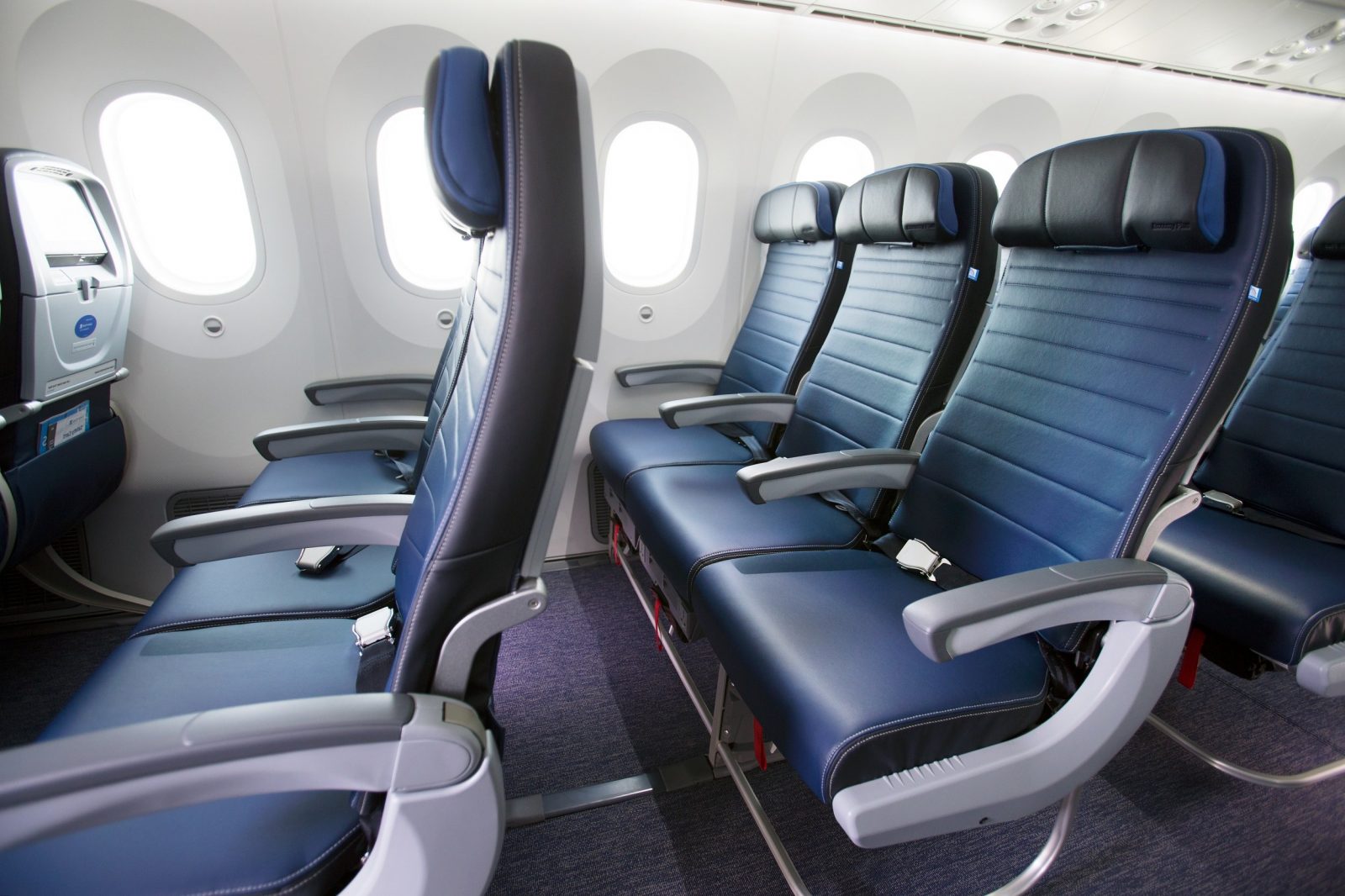
United Airlines has asked a California district court to dismiss with prejudice a class action lawsuit brought by two travelers who allege the carrier has been charging an extra fee to sit at window seats that don’t actually have a window.
The lawsuit made headlines around the world when it was filed in August, arguing that United should be held liable for selling at least one million ‘windowless window’ seats to unsuspecting passengers over the years.
The initial complaint was filed by Aviva Copaken and Marc Brenman, two United Airlines passengers, who claim they had either paid with cash or used United frequent flyer points to book window seats, only to then find that their seats didn’t actually have windows.
Aviva had paid up to $169.99 in additional fees to secure a window seat because she suffers from claustrophobia which is relieved by looking out of the window of the airplane.
She had used the United Airlines mobile app to select her preferred seat for an additional fee and selected what was marked as a ‘window seat’ on the online seat map.
What she didn’t know, however, was that the seat she had chosen didn’t have a window due to the alignment of the seats along the fuselage of the aircraft.
This is an issue that is particularly well known on some aircraft types, especially certain models of the Boeing 737, where the aircraft is manufactured without a window at row 11.
This is also the case on some Airbus A320 series aircraft, as well as the Boeing 787 Dreamliner range.
Despite the fact that this issue is well known, however, the lawsuit alleges that United continues to deceive passengers by clearly marking windowless window seats as ‘window seats’ in its online seat maps.
The airline also annotates these seats as having a window on mobile and paper boarding passes, but United says there’s a very simple explanation for this, and just because it’s advertised as a window seat doesn’t actually mean there’s any guarantee you’ll get a window.
United is one of the few airlines that uses a boarding method known as WILMA, which stands for ‘Window, Middle, Aisle’, in which passengers sitting in window seats are asked to board first, followed by middle seat passengers, and then finally passengers sitting in aisle seats.
WILMA is designed to make the boarding process as efficient as boarding, but to make it work, the airline has to clearly state on a passenger’s boarding pass if they are in a Window, Middle, or Aisle seat – even if the window seat doesn’t necessarily have a window.
“The use of the word ‘window’ in reference to a particular seat cannot reasonably be interpreted as a promise that the seat will have an exterior window view,” United’s attorneys say in their 22-page request to have the class action suit dismissed.
“Rather, the word ‘window’ identifies the position of the seat—i.e., next to the wall of the main body of the aircraft.”
United’s response adds: “Nothing in the screenshots [of boarding passes and online seat maps] indicates that the labeling of a seat as ‘window’ signifies anything other than the position of the seat on the aircraft.”
But even if passengers are misled by United’s online seat maps and boarding passes, the airline says the suit should be thrown out on the grounds that its conditions of carriage preclude any implied promise that a window seat should actually have a window.
United accepts that if a passenger paid for an amenity, then the contract of carriage allows for a refund of that fee, but puts an onus on the customer to request that refund within 90 days.
In the case of windowless, window seats, however, United argues that it never promised passengers who booked a window seat would get an exterior window view, but rather just a position next to the exterior wall of the aircraft.
“Plaintiffs have not alleged a clear and unambiguous promise by United… nor have they sufficiently alleged that their supposed reliance on the word ‘window’… was either reasonable or foreseeable,” United adds in its request to have the suit dismissed.
How to avoid a windowless window seat
While some airlines do now proactively annotate their online seat maps with which window seats don’t actually come with a window, the same can’t be said of most carriers.
There are, however, some other ways to avoid this pitfall, and perhaps the most accurate is using the independent seat map website Aerolopa. Simply select the airline you are flying with and then the aircraft type you will be flying on, and it pulls up a detailed seat map.
In the case of United’s Boeing 737-800 fleet, the seat map clearly shows a missing window at row 11 and only a partial view from row 12.
The one problem with Aerolopa is that you first need to know what aircraft type you will be flying on. This is usually indicated on the airline’s own online seat booking tool, although bear in mind that the aircraft type could be swapped right up to the departure time.


I have never been on a United flight that uses “WILMA” boarding. They board by group number. Various conditions determine what group your ticket is assigned to.
Studies have shown that random boarding is generally the most efficient boarding method (fastest fill).
United’s group number boarding would be more efficient if the entry door was at the back of the plane.
I eagerly await the judge’s response to United’s definition of “window” as “wall”. I expect it will involve a spit take.