




Delta Air Lines is using ‘dark patterns’ to deceive passengers who purchased fully refundable tickets at a premium to accept an expiring e-credit that allows the Atlanta-based carrier to profit unjustly from its deception, a new class action lawsuit against the airline alleges.
The lawsuit is being brought by a New York City resident, appropriately named Svetlana Sky, who believes that the claim against Delta could easily exceed $5 million for plaintiffs in the New York area alone.

The lawsuit, which was filed in a New York district court on May 1, accuses Delta of breach of contract and violations of New York business law, as well as negligent misrepresentation and unjust enrichment.
In her 16-page complaint against Delta, Svetlana says she was one of many consumers who were deceived by the airline’s “illegal dark pattern” to push e-credits rather than a full refund to the customer’s original form of payment as promised.
Svetlana says that she bought a fully refundable ticket for a premium with the understanding that if she had to change her travel plans, she could cancel her ticket and get all her money back without question or hassle.
But when she did have to cancel her ticket, Svetlana claims that Delta forced her to receive “inferior e-credits” that not only locked her into using Delta for her next flight booking, but that had a short expiration date.
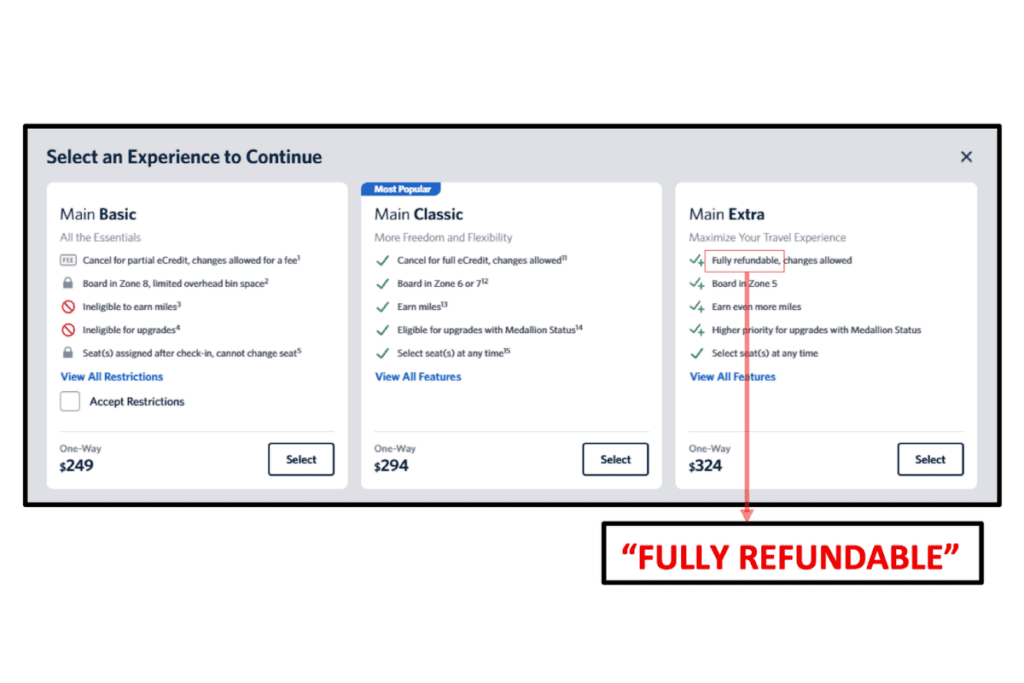
The issue, Svetlana explains, isn’t that Delta doesn’t allow customers to receive a full refund on a fully refundable ticket but that it hides this option on the flight cancellation page, deceiving passengers into believing that an e-credit is the only option available.
When a passenger goes to cancel a fully refundable ticket, the flight cancellation page loads with the e-credit option preselected. This option dominates the viewable part of the screen, and the ability to select a full refund to the original form of payment is hidden further down the screen.
This is known in website design as ‘above the fold,’ a borrowed term from the newspaper industry, which simply means that the content that is first seen by the viewer when a web page loads is what gets most attention from the consumer.
As website optimization specialist Optimizely explains: “Because of its high visibility, the content that you place above the fold should be the content that is most important to achieving your business goals.”
Delta passengers hoping for a full refund on a fully refundable ticket have to actively deselect the refund to e-credit option, scroll down the page, and then select the Refund to Original Form of Payment option.
Svetlana believes that this could constitute “illegal activity using tricks and traps to hide information” as defined by the Federal Trade Commission (FTC).
“For a consumer, including Plaintiff, who purchased a fully refundable fare, the ordinary and reasonable understanding is that canceling the ticket constitutes the request to refund the unused refundable portion – nothing more is required to refund the full purchase price to the original form of payment,” Svetlana’s complaint explains.
“Delta recognizes a substantial economic difference between cash-equivalent credits and carrier-limited travel credits. In fact, Delta values a cash refund at twice – 2x – the value of an e-credit on its own platform,” the complaint continues.
The valuation difference is “unavoidable,” Svetlana explains, because Delta’s e-credits expire just one year after they have been issued. As a result, not only does Delta control the cash equivalent until the e-credit is used, but if they end up expiring, Delta pockets the cash.
The complaint concludes: “Defendant’s misleading and deceptive practices proximately caused harm to Plaintiff and the proposed class members who suffered an injury in fact and lost money or property as a result of Defendant’s deceptive conduct.”
Delta has yet to respond to the lawsuit in federal court.
Before the end of the Biden administration’s term, the Department of Transportation changed refund rules for passengers on a significantly delayed or canceled flight, forcing airlines to automatically offer a full refund when a passenger decided to abandon their travel and cancel their ticket.
Until the rule change, it was up to airlines to decide when passengers were entitled to a refund due to a ‘significant change’ to their itinerary, resulting in wildly differing rights for passengers depending on which airline they chose to fly with.


Delta’s behavior is once again reprehensible in this example. Remember when they stood for integrity, quality, and value? It’s only been a little over a decade.