



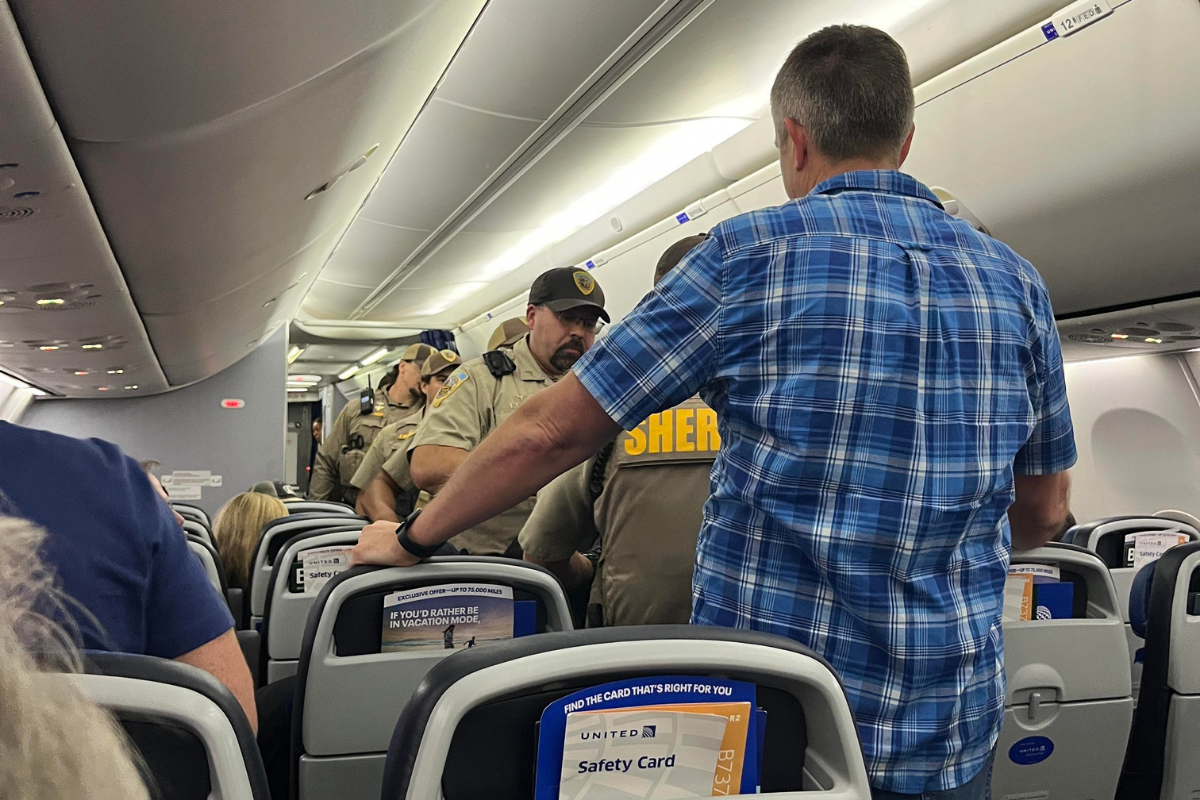
The pilots of a United Airlines flight from Chicago O’Hare to Minneapolis declared a Level 4 passenger threat just 20 minutes after takeoff and made an emergency diversion to Madison after a Russian citizen on board the plane reportedly attempted to breach the cockpit.
The alert was taken so seriously that United Airlines sent a broadcast message to all of its other airborne flights, alerting pilots of the situation so that they could keep their cockpits secure in the event that the incident was part of a coordinated attack.
United Airlines flight UA-2005 departed Chicago O’Hare at around 8:30 pm on Friday for what should have been a routine two-hour flight to Minneapolis.
The Boeing 737 had just climbed to a cruising altitude of around 30,000 feet as it headed north west towards Minneapolis before it suddenly veered off course and headed straight towards Madison.
On board the packed airliner, a serious unruly passenger incident was unfolding. The suspect had reportedly caused issues even before the plane departed when he got upset with the flight attendants for telling him to sit down as the aircraft was taxiing for departure.
Once in the air, the man’s behavior deteriorated and he allegedly started to make threats towards his seatmates and crew members. He then charged the flight deck door, prompting the pilots to put the cockpit into lockdown and declaring the highest level of threat possible.
Thankfully, there were off-duty law enforcement officers on board the aircraft who helped to subdue the unruly passenger before the plane made a safe landing in Madison, and he was taken into custody.
When dealing with unruly passenger incidents, airlines use an internationally recognized matrix to report the level of threat posed to the flight:
- Level 1 – Disruptive Behavior: Billigerent behavior, failing to follow lawful orders of the crew, swearing and cursing.
- Level 2 – Physically Abusive Behavior: Physical contact between the unruly passenger and another passenger or crew member, punching, shoving, or pushing.
- Level 3 – Life Threatening Behavior: The use of or threat of a weapon, physical behavior that could threaten another person’s life, such as strangling.
- Level 4 – Breach of the Cockpit: Any attempt or actual breach of the cockpit is treated as a Level 4 threat. Hijack protocols are instigated.
As soon as any form of unruly passenger incident is reported, flight crew members will take extra precautions to ensure that the cockpit door is secure and not opened unnecessarily, as there could be a risk that one person’s behavior is being used as a distraction.
Cockpit doors are both bullet and bomb proof and can only be unlocked from the inside. Even emergency access codes used from outside can be overridden from within the cockpit.
When closed, cockpit doors are pretty much impenetrable, although aviation safety experts have long warned of the danger posed to airliners during the very short windows that the door has to be opened in-flight so that the pilots can use the bathroom.
To mitigate this risk, U.S. airlines are now required to install secondary cockpit doors on newly built planes, although full implementation isn’t yet enforced. The secondary barrier isn’t bullet or bomb proof but is designed to provide added protection during those short windows that the main cockpit door is open in-flight.
U.S. airlines are not required to retrofit older planes with these barriers, and, as it stands, no airline has announced plans to voluntarily roll out the barriers on aircraft not covered by the mandate.


Almost everyday we hear a story about an incident on an airplane. So glad I did my traveling when I was young.