



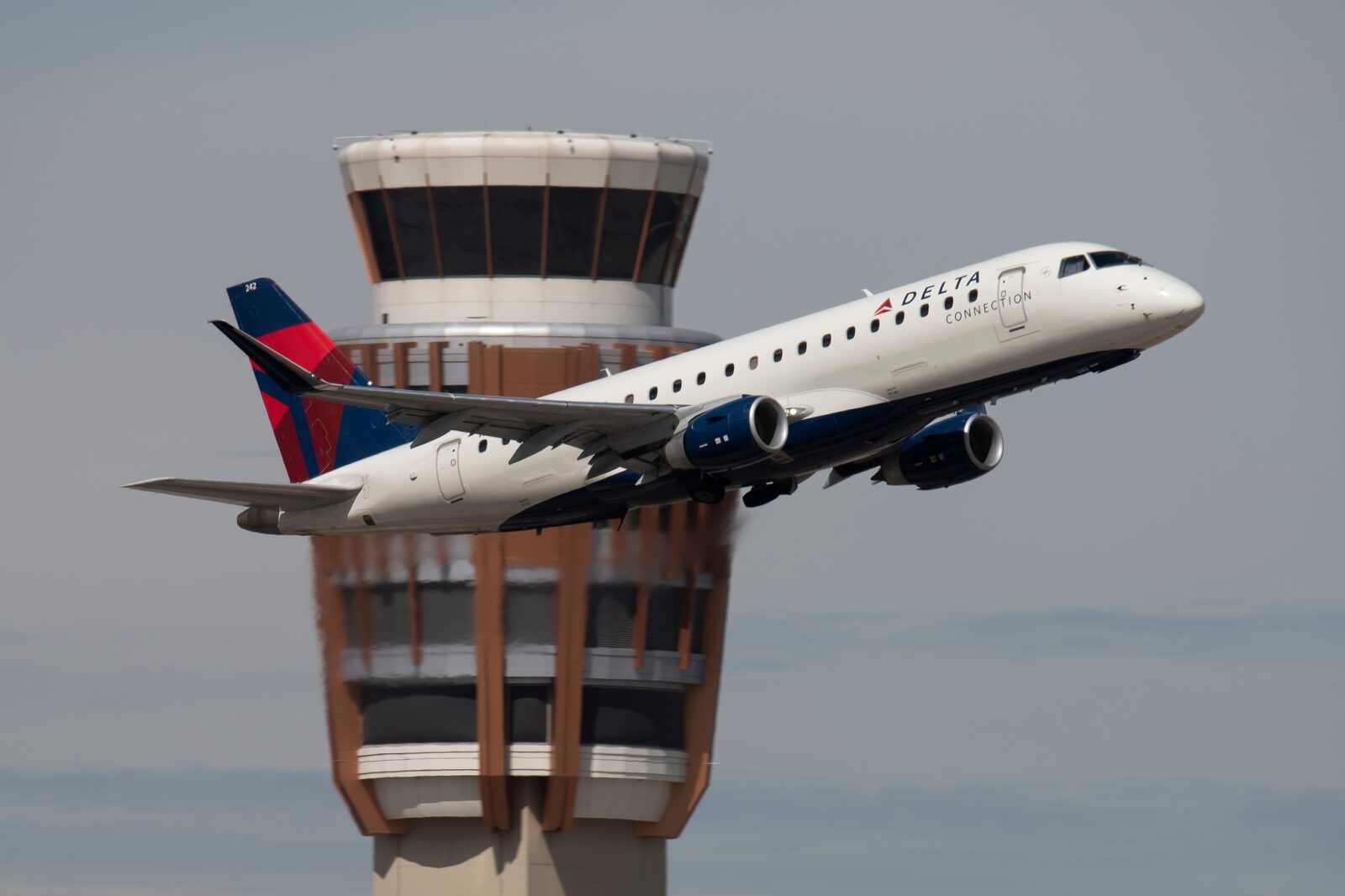
Last Thursday, a terrifying drama unfolded onboard a Delta Connection flight operated by regional carrier SkyWest, after Mario Nikprelaj, a 23-year-old man from Nebraska, tried to open the plane’s emergency exit as it flew high above the skies of Iowa.
The flight attendants, helped by several passengers on board the Bombardier regional jet, bundled on top of Nikprelaj as a desperate act of tug-of-war played out to stop him from attempting to open the door.
Nikprelaj now faces federal charges of interference with flight crew members, which, if convicted, carries a maximum sentence of 20 years imprisonment, as well as a potential fine of as much as $250,000.
This is just one of a growing number of similar cases in which passengers have reached for the emergency exit mid-flight, but the question is, was it really possible for Nikprelaj to have opened the emergency exit?
It may surprise you to learn that the answer is not a clear-cut no, and, in fact, there have been instances of passengers successfully opening the emergency exit at lower altitudes.
The general thinking is that it is impossible for the emergency exit to be opened in-flight, and this is because of the pressure difference between the outside of the plane and inside the cabin.
Most airplane cabins are pressurized to an altitude of around 8,000 feet, whereas the average cruising altitude is 30,000 feet. At these altitudes, the pressure difference makes it humanly impossible for the emergency exit to be opened.
Many commercial aircraft rely on this simple scientific fact to secure the emergency exit from accidental or even deliberate activation mid-flight, although recent history tells us it is, in fact, possible to open the emergency exit at lower altitudes when there is far less of a pressure difference.
Recent Cases Of Passengers Trying To Open The Emergency Exit Mid-Flight
- April 2025 – A man twice tried to open the emergency exit of a Sydney-bound flight before being restrained by cabin crew.
- November 2024 – Flight attendants struggled to restrain a man who lunged at the emergency exit of a Korean Air Airbus A330.
- February 2024 – A passenger on an American Airlines flight from Albuquerque to Chicago attempts to open the over-wing exit of a Boeing 737 just after takeoff.
- May 2023 – The emergency exit of an Asiana Airlines Airbus A321 is opened by a passenger during the final descent to landing
- February 2022 – A passenger on a United Express regional jet flying to Florida managed to partially open the emergency exit during final descent.
The most famous example of this occurring is Asiana Airlines flight 8124 in May 2023, when a passenger sitting beside one of the emergency exits managed to activate the door as the plane was on approach for landing.
Dramatic video taken by other passengers showed the moment that wind swept through the cabin from the open door before it landed safely in Daegu, South Korea.
The airline was convinced that a mechanical fault was to blame because staffers just couldn’t comprehend that a passenger could have been responsible, and it wasn’t until the perpetrator admitted to the crime that the true nature of the incident came to light.
Just over a year earlier, however, there was a similar incident aboard a US plane when an unruly passenger managed to partially open the emergency exit of an Embraer E45 regional operated by CommutAir on behalf of United Express.
As the man partially opened the door, a flight attendant desperately tugged on his hand to prevent him from swinging the door open any further, while passengers, including an off-duty Air Marshal, waded in to pull the man away from the door.
And in February 2024, passengers onboard an American Airlines Boeing 737 felt a sudden gush of wind as a passenger managed to partially open an overwing emergency exit as the plane was in its initial ascent after takeoff from Albuquerque.
Again, passengers managed to wrestle the man away from the door and get the door sealed before it was fully opened.
The Most Dangerous Times That An Emergency Exit Could Be Opened In-Flight?
What we’ve learned from all of these recent incidents is that it is possible to open an emergency exit in-flight, with the most dangerous times being in the initial ascent during takeoff and during final approach for landing, while the plane is at lower altitudes.
The exact altitude at which that risk dissipates is dependent on a number of factors, although as a general rule of thumb, once an aircraft reaches an altitude of around 10,000 feet, it should be impossible to open the emergency exit door.
What Safety Mechanisms Are In Place?
Emergency exits are designed quite deliberately to be easy to operate, even by a layperson with no formal training, so it’s unlikely that aircraft manufacturers are going to add any additional steps to the door-opening process to mitigate the risk of unruly passengers trying to open the emergency exit mid-flight.
That being said, there are a number of safety mechanisms already in place on various aircraft models.
For example, some airplanes, such as the Boeing 777, have a speed lock system fitted to the emergency exits, which locks the doors shut once the plane has reached a certain speed during takeoff.
As is probably evident, however, speed locks are relatively rare and do not feature on aircraft like the Airbus A320 series, which was involved in the Asiana incident.
Generally speaking, it is up to flight attendants to guard the emergency exits, although in the case of the Asiana incident, there wasn’t a flight attendant positioned right by the emergency exit that was opened.
What About Over-Wing Exits?
Over-wing exits on Airbus A320 series and Boeing 737 single-aisle planes are designed to be operated by passengers, which is why they are sometimes referred to as ‘self-help exits’.
These exits are not guarded by a flight attendant and are difficult to monitor during takeoff and landing when crew members are strapped into their jumpseats at the front and rear of the plane.
The only warning that anyone will get is an alarm that activates as soon as someone attempts to open the overwing exit.
What Other Damage Could a Failed Attempt At Opening The Emergency Exit Cause?
Even if it’s physically impossible to open an emergency exit at high altitude, the act of pulling or tugging on the door lever could cause damage to the inflatable slide that is attached to the door.
Clearly, this is a major safety concern and it’s therefore important for any tampering with the lever to be stopped as quickly as possible.
Check Out More Crew Insider Stories