



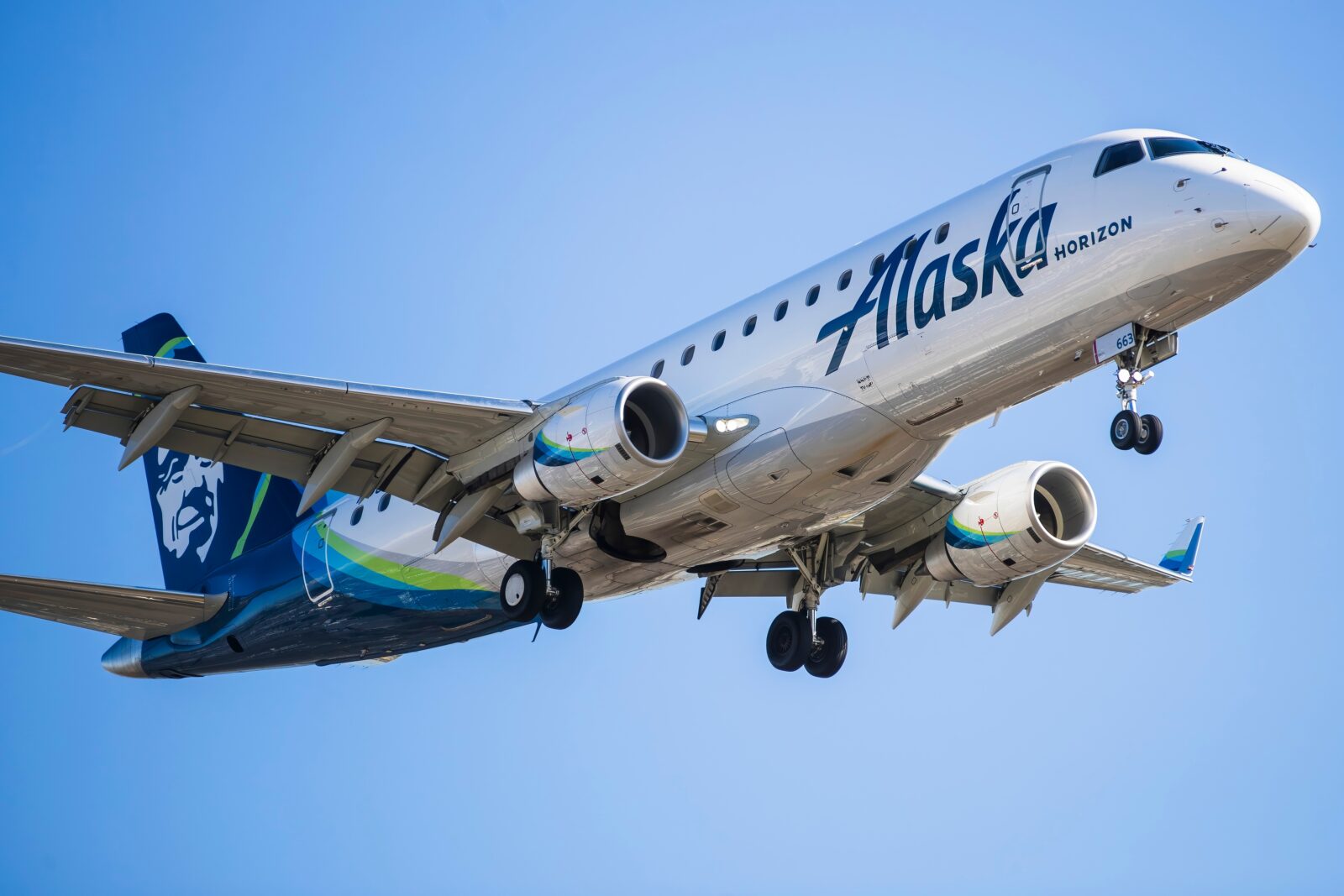
A recently released cockpit voice recording from inside the flight deck of an Alaska Airlines regional jet reveals the chaos that unfolded as an off-duty pilot who was ‘jumpseating’ home while still high on magic mushrooms attempted to kill the engines mid-flight.
Despite initially being charged with 83 counts of attempted murder for every passenger and crew member on board the October 22, 2023, flight, former Alaska Airlines pilot Joseph Emerson eventually reached a plea deal for a single federal charge of Interference with flight crew members and attendants.
Late last year, the court case was wrapped up with Emerson being sentenced to time served and probation.
Off-duty pilot tries to shut down engines mid-flight
On October 22, 2023, Emerson was traveling home from Seattle to San Francisco after attending a remembrance gathering for his best friend, who had recently died from an untreated heart problem.
Emerson was off-duty and using his ‘non-rev’ benefits to get home to San Francisco. All the passenger seats on flights to SFO were fully booked, so, as an off-duty pilot, Emerson was allowed to sit in a spare ‘jumpseat’ in the cockpit of Alaska Airlines flight 2059 (operated by Alaska’s wholly owned regional subsidiary Horizon Air).
Emerson had been struggling to process his friend’s death, but fearing he would lose his flying license if he sought professional mental health support, he decided to take Magic Mushrooms for the first time ever.
He thought the effects of the mushrooms would wear off within eight hours, but he ended up suffering a rare adverse reaction known as Hallucinogen Persisting Perception Disorder, which resulted in Emerson becoming detached from reality and feeling like he was in a dream that he couldn’t escape from.
After the plane had taken off, Emerson became convinced that he was in a dream and had to wake up immediately. To do so, he pulled the emergency shut-off handles to both engines.
The two operating pilots quickly intervened, pulling his hands away from the shut-off handles and then pushing him out of the cockpit and into the cabin, where he attempted to reach for the emergency exit door handle before being pulled back by a crew member.
Cockpit voice recorder exchange
Much of what occurred on Flight 2059 has been described in detail in various court filings, but this is the first time that the exchange between Emerson and the pilots has been released from the Cockpit Voice Recorder (CVR).
The recording starts shortly after Emerson repeatedly started to mutter “I’m not okay, I’m not okay,” which prompts one of the pilots to check on his welfare. Moments later, Emerson reaches for the engine shut-off levers, and an expletive-laden reaction from one of the pilots.
Pilot: What's that?
Emerson: I'm not okay.
Pilot: What's wrong?
Emerson: I gotta get home.
Pilot: You want to get home?
Emerson: Yeah
<Emerson pulls emergency engine shut off levers>
Pilot: F**k s**t! F**k!
Dude, what are you doing?
What's going on?
Pilot to ATC: Horizon, we need to make an emergency landing
Air traffic control: I'm sorry who was that?
Pilot: It's Horizon 2059,
We got a jumpseater just tried to shut our engines off.
We need to go direct to Portland, now.
Emerson avoids jail time
Prosecutors initially proposed charging Emerson with 83 counts of attempted murder for all the passengers and crew aboard Flight 2059. A grand jury, however, ended up indicting Emerson with 83 counts of recklessly endangering another person.
Emerson was held on remand for a short period before being released on bail as the case worked its way through the court system. By September 2025, federal prosecutors decided to drop the reckless endangerment charge after reaching a plea deal with Emerson.
The deal involved Emerson pleading guilty to a single count of Interference with flight crew members and attendants.
The maximum possible sentence for this crime is 20 years imprisonment and a $200,000 fine. In the end, though, Emerson was sentenced to time served for the period he was on remand and ordered to complete probation.
Since the incident, Emerson has been banned from flying, but he has turned his attention to improving mental health resources for pilots and has started a non-profit with his wife called Clear Skies Ahead.
As well as the federal prosecution, Emerson pleaded no contest to 83 state charges of recklessly endangering another person. For these charges, Emerson was sentenced to time served and ordered to complete 664 hours of community service.
He was also ordered to pay Alaska Airlines $60,000 in restitution for the cost of the diversion and has to complete five years of probation. During this time, he is also banned from being within 25 feet of an operable airplane.


An interesting thing about this is how it shows that most of our security is done as theater. It’s a sad but factual reality that the single largest failure point in commercial aviation leading to crash fatalities has been insane pilots sabotaging their own planes. On some level there is little that can be done about it because somebody needs to fly the plane and we don’t yet have the technology to do away with pilots and this failure point. Yet the FAA still allows the practice of non-Rev jump seating which puts unneeded extra people in the cockpit which multiplies the relative and absolute risk of what is probably the single largest failure point leading to crashes and fatalities – which thankfully didn’t happen here. If this is an acceptable risk – and perhaps it is – so are the many other things the FAA prohibits.